


Space City releases new flood scale.
Space City releases new flood scale.


Joined:
X days ago
# Posts:
X,XXX
Contributor Points:
X


Space City releases new flood scale. Eric Berger · Tuesday, July 29, 2025 7:04 AM In brief: In today's post we reveal the new design and content for our flood scale. We have made changes based on research conducted by the University of Houston. Although rain chances will increase later this week, we also anticipate no need to use the new flood scale any time soon. Updated flood scale - This morning we are pleased to announce an update of our flood scale, which is intended to help guide expectations for people in the greater Houston region when it comes to the potential for flooding. We first introduced our flood scale in 2019, after Hurricane Harvey, and have used it dozens of times since then. But we really did not understand how people were using it. Now, with the help of some researchers from the University of Houston, we do. A professor of
Psychology, Steven Paul Woods, reached out to Matt a couple of years ago, and together they and one of his doctoral students, Natalie C. Ridgely, worked to perform a study of the scale and whether it was effective at communicating risk. Later this morning we will publish a summary of the study, and its results, written by Woods and Ridgely. Be sure and check back for that. As a result of this study, we have made some changes in the structure of the scale to simplify it, and added recommended actions. Reliant provided a cleaner design. What thrills me the most is that this scale was created here in Houston, and improved by local researchers who care about this community just as much as we do. It is by Houston, for Houston. Our new scale appears below: 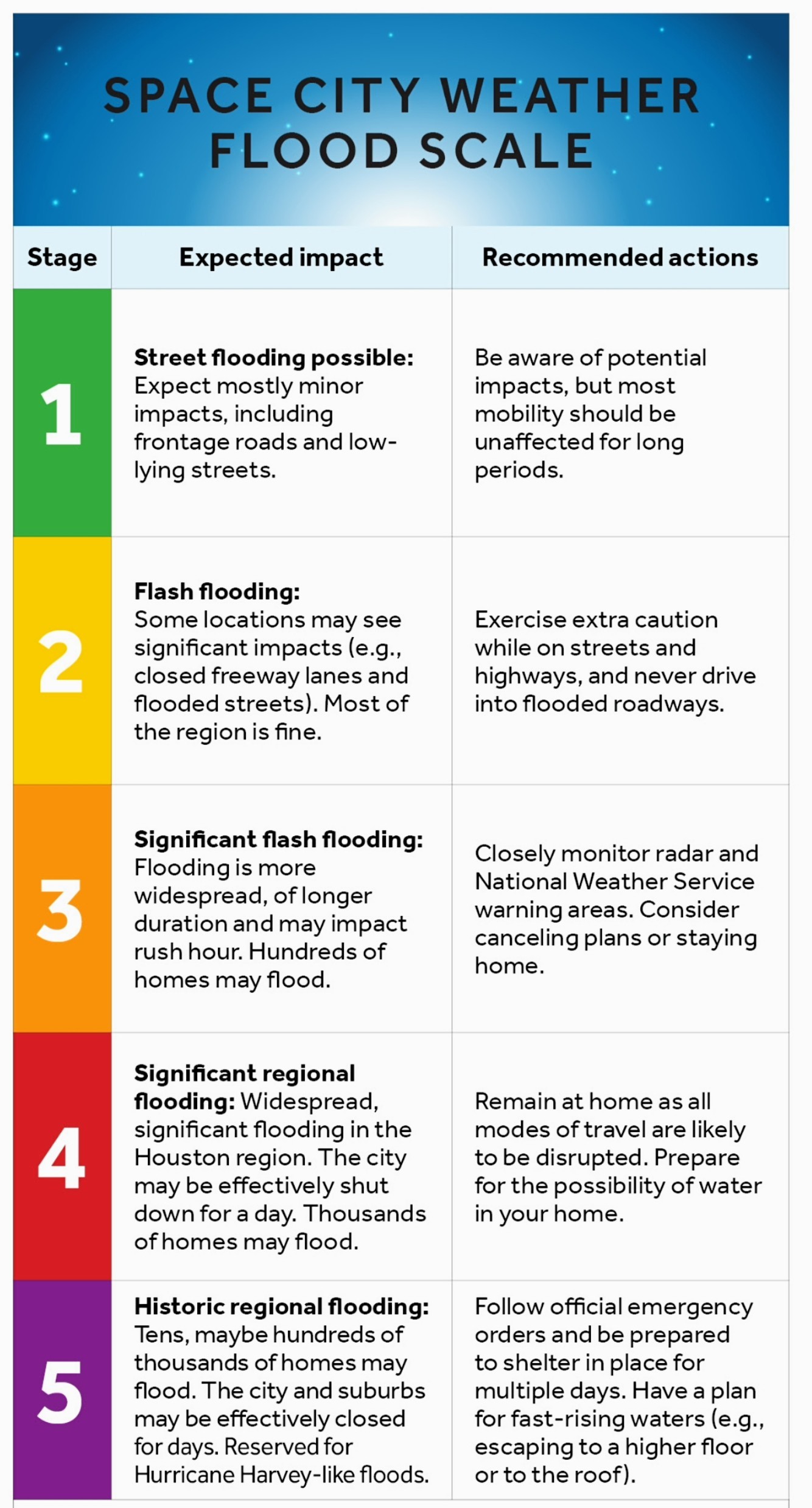


peppermintstick, CatalinaKitKat and wmubronco + 3 more reacted Psychology, Steven Paul Woods, reached out to Matt a couple of years ago, and together they and one of his doctoral students, Natalie C. Ridgely, worked to perform a study of the scale and whether it was effective at communicating risk.
Replies:
It's still odd to me that the phrase "shelter in place" is featured, but "evacuate"(which is obviously not for everyone) gets no mention. Surely there are some locations where evacuating is a better plan. It's not easy to read that
A) hoping to remain safe
and
B) waiting to be rescued if plan A fails, is the best general advice that can be given. It seems like more complete advice is given for active shooters.
billcherie2 and TEXASGIRLMAMMA reacted A) hoping to remain safe
and
B) waiting to be rescued if plan A fails, is the best general advice that can be given.
It's still odd to me that the phrase "shelter in place" is featured, but "evacuate"(which is obviously not for everyone) gets no mention. Surely there are some locations where evacuating is a better plan. It's not easy to read that A) hoping to remain safe and B) waiting to be rescued if plan A fails, is the best general advice that can be given. It seems like more complete advice is given for active shooters.
Spork : I think by the time we are at stage 4 and 5 there can not be an evacuation. By then I think it has to be shelter in place. I think it would be worse to be driving out on the streets. It seems like this kind of flooding always happens at night and it is always hard to predict.
Space City releases new flood scale. Eric Berger · Tuesday, July 29, 2025 7:04 AM In brief: In today's post we reveal the new design and content for our flood scale. We have made changes based on research conducted by the University of Houston. Although rain chances will increase later this week, we also anticipate no need to use the new flood scale any time soon. Updated flood scale - This morning we are pleased to announce an update of our flood scale, which is intended to help guide expectations for people in the greater Houston region when it comes to the potential for flooding. We first introduced our flood scale in 2019, after Hurricane Harvey, and have used it dozens of times since then. But we really did not understand how people were using it. Now, with the help of some researchers from the University of Houston, we do. A professor of Psychology, Steven Paul Woods, reached out to Matt a couple of years ago, and together they and one of his doctoral students, Natalie C. Ridgely, worked to perform a study of the scale and whether it was effective at communicating risk. Later this morning we will publish a summary of the study, and its results, written by Woods and Ridgely. Be sure and check back for that. As a result of this study, we have made some changes in the structure of the scale to simplify it, and added recommended actions. Reliant provided a cleaner design. What thrills me the most is that this scale was created here in Houston, and improved by local researchers who care about this community just as much as we do. It is by Houston, for Houston. Our new scale appears below:
StormChaser : Has Houston ever had hundreds of thousands of homes flood in the same event?
StormChaser : Has Houston ever had hundreds of thousands of homes flood in the same event?
TEXASGIRLMAMMA : *In Harris County, an estimated 120,000 structures were flooded.
TEXASGIRLMAMMA : Harvey. Over 200,000 homes and apartments had water damage after Harvey. I had to look up the exact stats and they actually increased the number of buildings effected! *During Hurricane Harvey in 2017, more than 204,000 homes and apartments in Harris County sustained damage from flooding. *In Harris County, an estimated 120,000 structures were flooded. A more recent analysis in 2024 indicates that nearly HALF of Houston's homes (209,000 out of 501,000) experienced some form of damage, either from flooding or other storm-related issues.
StormChaser : WOW! That is amazing and I had no idea it was that extensive. Thanks!
It's still odd to me that the phrase "shelter in place" is featured, but "evacuate"(which is obviously not for everyone) gets no mention. Surely there are some locations where evacuating is a better plan. It's not easy to read that A) hoping to remain safe and B) waiting to be rescued if plan A fails, is the best general advice that can be given. It seems like more complete advice is given for active shooters.
Spork : Surely there are some locations where evacuating is a better plan.
Spork : Its more about the situation and also the time table.
More info..... We're updating our flood scale. Here's why. Eric Berger · Tuesday, July 29, 2025. How can we help Houstonians better prepare for major weather events? An impassioned tweet from Matt about the challenges of weather communication during the 2022 hurricane season led us to wonder: Can we use psychological science to help Houstonians better understand and prepare for major weather events? We posed this question to Matt, who was enthusiastic about the potential of a meteorology-meets-psychology research collaboration. Matt and Eric were specifically curious if we could boost the usefulness of the beloved Space City Weather (SCW) Flood Scale (Lanza & Berger, 2023). Old scale:
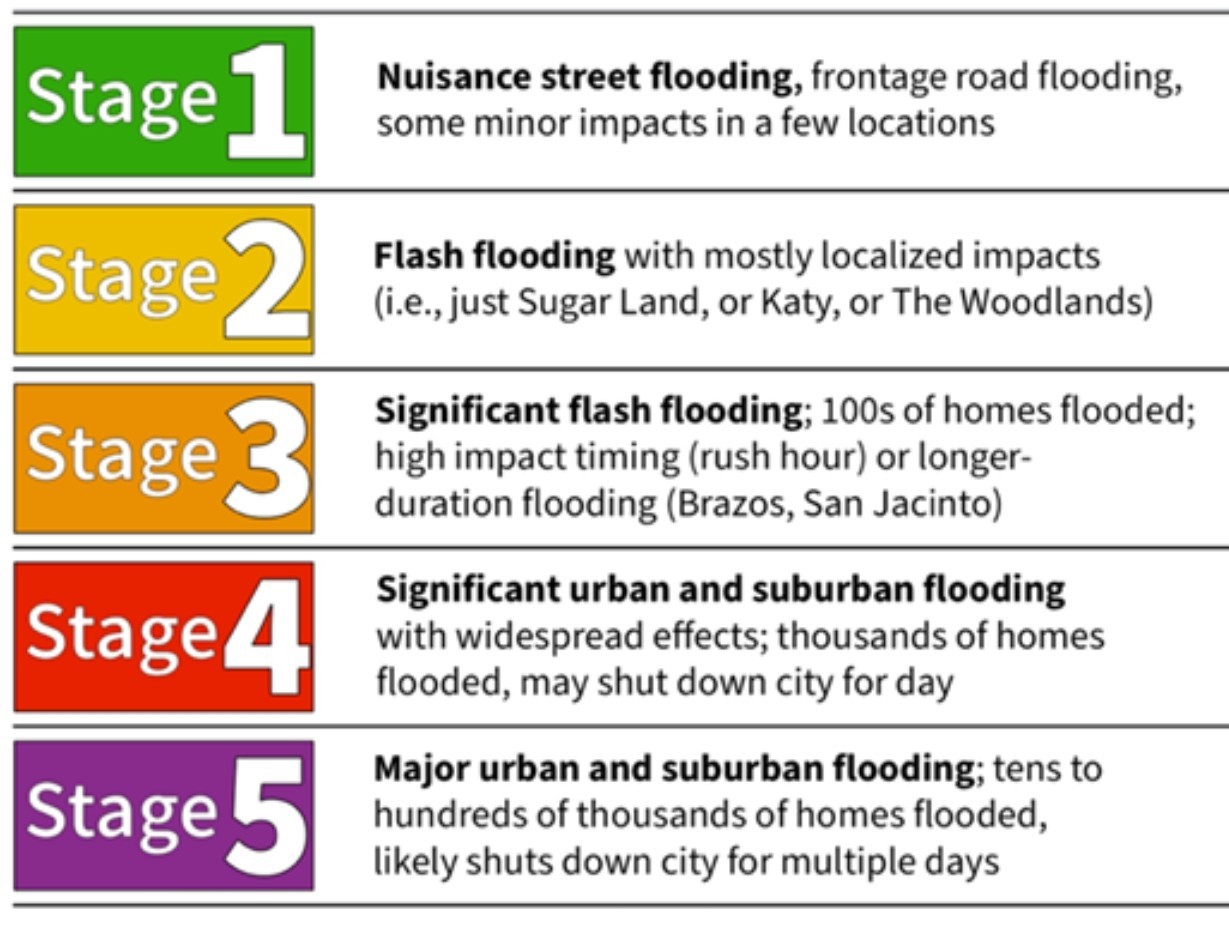 The original goal of the SCW Flood Scale was to help Houstonians better understand and prepare for a wide range of flooding events. The SCW Flood Scale uses a color-coded numerical rating system (1 green = nuisance street flooding to 5 red = severe life-threatening flooding) and provides a historical flooding event for context (e.g., Hurricane Harvey). *But does it nudge people to actually prepare for flooding?* This is important because even when people know the flooding risk of an approaching storm, they may not turn that knowledge into useful ways to protect themselves (i.e., weather-protective behaviors). There are meaningful gaps between what we know, what we intend to do, and what we actually do (e.g., Fishbein, 1979). Providing people with direct informational cues can help bridge these gaps (Grounds & Joslyn, 2018; Woods et al., 2022). So, we designed a simple experiment to see whether including examples of appropriate weather-protective behaviors at each level of the SCW Flood Scale helps people do a better job of planning for storms. How did we do this study? The Storm Forecasts: With Matt and Eric's help, we created three realistic storm forecasts that varied in severity on the SCW Flood Scale (i.e., Stages 1, 3, and 4). We presented these storm forecasts to people in a randomized order. The Weather-Protective: Behaviors: After hearing the three storm forecasts, participants were asked to rate their intentions to do 12 different weather-protective behaviors on a scale of 1 (unlikely) to 5 (very likely). Higher scores mean stronger plans to practice useful weather-protective behaviors. We included actions that would be helpful in a flood, like reducing the amount of time spent on the roads, gathering necessary supplies, charging electronic devices, and listening for emergency alerts. We also included actions that sounded reasonable, but may not be helpful during a flooding event, like wrapping exposed pipes, securing the foundation of their home, or sheltering in a basement. The Experimental Groups: The study participants were randomized into one of two groups: 1) A control group who saw the standard version of the SCW Flood Scale; or 2) A weather-protective cue group who saw a new version of SCW Flood Scale that included examples of weather-protective behaviors at each level of flood risk (e.g., Stage 1 = Consider reducing time on the roads; Stage 3 = fuel vehicles; Stage 5 = identify safe evacuation routes). The Study Participants: We recruited 100 healthy adults from 5 Gulf Coast states to participate in this study. Importantly, the control group and the weather-protective cue group did not differ in demographic factors (e.g., age, education), cognitive ability, weather literacy, and experience with storms. Did the experiment work?
 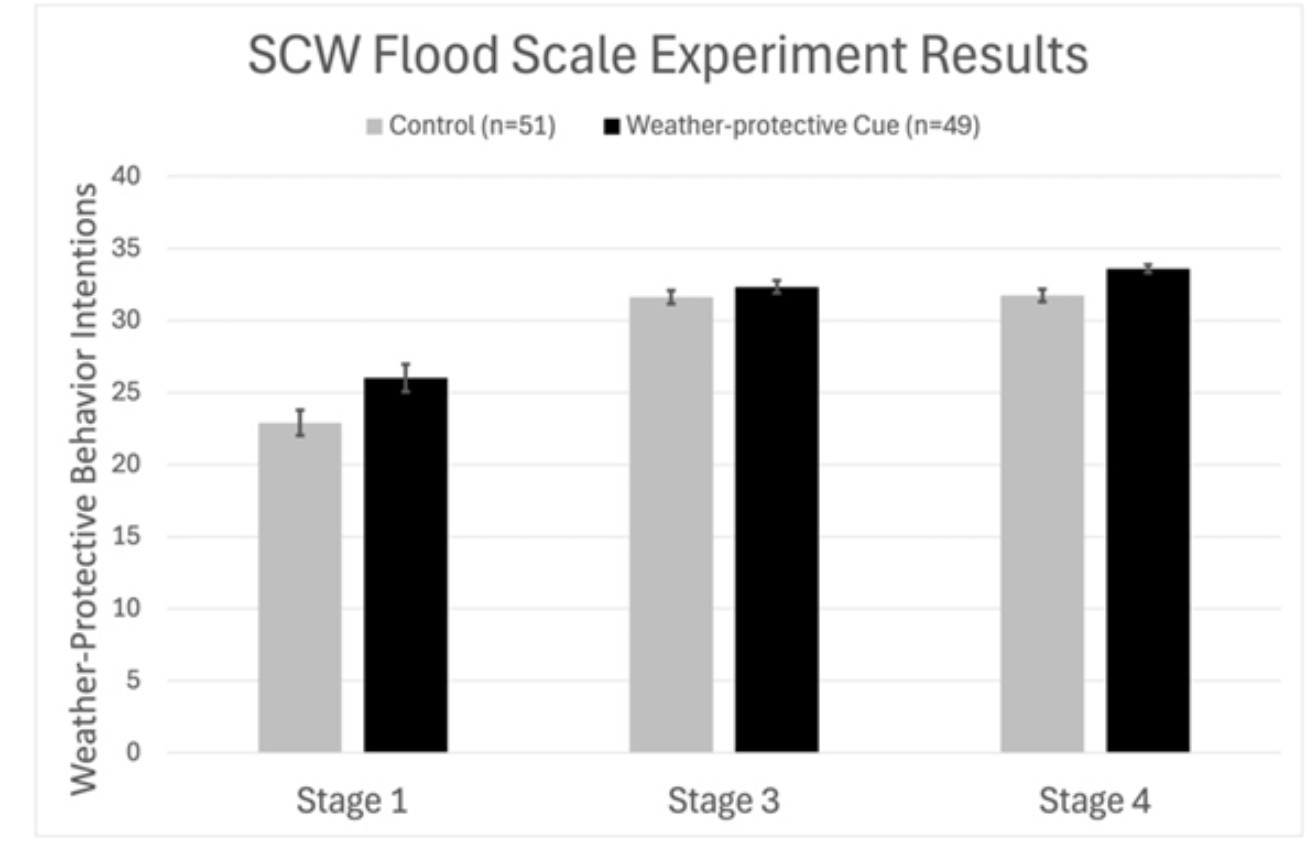 In brief, yes! People in the weather-protective cue group did a better job of planning for the storms. Figure 1 shows the flood-protective behaviors on the vertical axis, where higher scores mean better plans to practice useful flood-protective behaviors. The individual storm forecasts are on the horizontal axis. You can see that the benefits of the protective cues varied by storm severity. The flood-protective cues had strong benefits for the most (Stage 4) and least (Stage 1) severe storms, but only weak benefits for the Stage 3 storm, which was a fast-moving wind event for which flood protective recommendations may be somewhat less clear. Encouragingly, we also found the largest benefits of the flood-protective cues among people who had the lowest levels of baseline weather preparedness. That means we were able to improve flood-protective plans for the people who were at greatest risk of being unprepared. Finally, we found that the flood-protective cues had no effects on non-beneficial actions (e.g., wrapping household pipes). In other words, the flood-protective cues only nudged people towards doing things that are known to be helpful for their health and property during a flooding event. What's next? The results of this simple experiment suggest that adding flood-protective action cues to the SCW Flood Scale increases the likelihood that people will plan to safeguard their home and health in response to flood forecasts. We are excited that Matt and Eric will be working with Reliant to add the flood-protective cues to the SCW Flood Scale moving forward. And we hope that this new version of the SCW Flood Scale will provide additional support and comfort to Houstonians as they prepare for future storms. We are currently looking at whether the benefits of the flood-protective cues vary across people who may be particularly vulnerable to weather impacts, including older people and those with serious medical conditions. We are also curious to learn more about what leads people to choose non-beneficial weather-protective actions in these situations. Finally, we would like to know whether we can help Houstonians better understand and use heat warnings. So, stay tuned for more meteorology-meets-psychological science! Steven Paul Woods, Psy.D. and Natalie C. Ridgely, Ph.D.
Department of Psychology, University of Houston
RolloTomaso reacted Department of Psychology, University of Houston
StormChaser : WOW! That is amazing and I had no idea it was that extensive. Thanks!
TEXASGIRLMAMMA : *500 homes in Atascocita.
*500 homes in Humble.
*300 in Kingwood alone.
TEXASGIRLMAMMA : Yup. Here are the Kingwood numbers. *4000 Homes were damaged in Kingwood. *500 homes in Atascocita. *500 homes in Humble. *Businesses: 3300 (KW/Humble/Atas areas combined) *300 in Kingwood alone. Total: 4184 homes flooded in this area - partly because of the release of 80,000 cfs from the Lake Conroe dam.
StormChaser : I always just think about the homes and businesses in our general area. Lake Conroe should not have done that! « Back to Chat
Views: 469
# Replies: 10